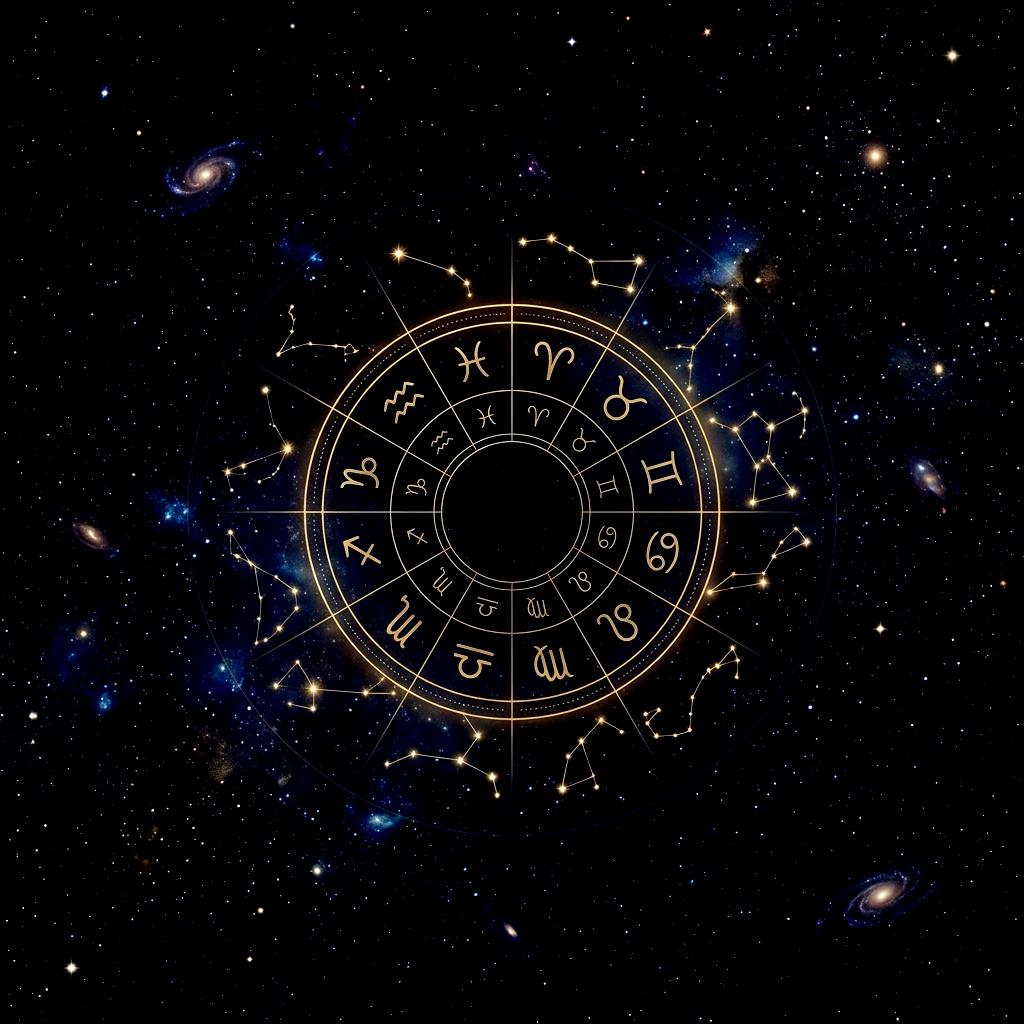
You’ve seen them in newspapers, apps, and websites. “Today your career gets a boost.” “Watch your finances this week.” “Love is in the air.” But what is a horoscope really? And how does anyone come up with these forecasts? The word horoscope comes from the Greek “horoskopos,” which means “observer of the hour.” Back in ancient times, astrologers looked at the sky at a specific moment, usually a birth, and mapped out what they saw. That original map was the horoscope. Today the word means something a little broader.
A horoscope is keyly a snapshot of the sky from a particular place and time. When astrologers talk about your horoscope, they usually mean the positions of the Sun, Moon, and planets relative to Earth at the moment you were born. But the horoscopes you see published daily or weekly are something else. Those are generalized forecasts written for each zodiac sign based on where the planets are moving right now. They are less like a photograph and more like a weather report.
To write a horoscope, an astrologer starts with the current positions of the planets. They look at the ephemeris, which is a table that shows where every planet is on any given day. The Sun moves about one degree per day through the zodiac. The Moon moves about 13 degrees per day, changing signs every two and a half days. The outer planets move much slower, jupiter spends about a year in each sign. Saturn stays roughly two and a half years. Uranus takes seven years per sign. Neptune and Pluto move so slowly that they spend decades in a single sign.
Once the astrologer knows the current planetary positions, they look at how those planets interact with each other. That’s where aspects come in. If Venus and Jupiter are forming a trine, that’s a harmonious aspect that suggests good things for love and money. If Mars is squaring Saturn, that is a tense aspect that points to frustration or delays. The astrologer also looks at which house each planet is traveling through in a temporary chart called a transit chart.
Then comes the tricky part. The astrologer has to translate all that technical information into something useful for each Sun sign. They generalize. A person with a Gemini Sun will experience a Mars transit differently than a person with a Scorpio Sun. So the horoscope writer takes into account how the current energy typically affect each sign. It is a mix of astronomy, symbolism, and a whole lot of intuition.
Not all horoscopes are created equal. A daily horoscope in a newspaper is usually very short and generic. A weekly or monthly horoscope gives more depth. A personal horoscope written for your exact birth time and place is the most detailed of all. That is called a transit reading, and it tells you how current planetary movements are hitting your specific chart.
So why do horoscopes sometimes feel so accurate? A big part of it is the Barnum effect. That is a psychological phenomenon where people believe vague, general statements are written specifically for them. Phrases like “You’ve untapped potential” or “You are stronger than you realize” apply to almost everyone. Good horoscope writers know how to craft language that feels personal while staying broad enough to fit a large audience.
Think about it, But theres more to it than just psychology. Astrology operates on a symbolic level that has resonated with humans for millennia. There’s something powerful about looking at the sky and seeing patterns that match your inner experiences. Whether it works because of actual cosmic influence or because it gives you a framework for thinking about your life, horoscopes help people reflect. They make you pause and consider your choices, your relationships, and your direction.
Horoscopes have a long history. The first personal horoscopes appeared in ancient Mesopotamia around 410 BCE. By the Hellenistic period, Greek astrologers were casting charts for everyone from emperors to slaves. The tradition continued through the Islamic Golden Age, the European Renaissance, and into the modern era. Newspaper horoscopes became popular in the early 20th century. A British astrologer named R. H. Naylor wrote the first mass-market Sun sign column for the Sunday Express in 1930. The rest is history.
No doubt, There are different types of horoscopes you should know about. A natal horoscope is your birth chart. A transit horoscope looks at current planetary movements. A synastry horoscope compares two charts to see romantic or business compatibility. An electional horoscope helps you pick the best time to start something like a wedding or a business. A horary horoscope answers a specific question based on the moment you ask it. Each type serves a different purpose.
If you want to start reading your own horoscopes more deeply, the best thing you can do is learn your birth chart and your Sun sign gives you the basic flavor, but your Moon sign, Rising sign, and planetary placements add layers.
Look, Critics of horoscopes often point out that they are not scientifically proven. That is true, but that doesn’t mean they are worthless. Horoscopes serve a purpose similar to meditation or journaling. They give you a moment of reflection and a new perspective. If a horoscope helps you make a decision or feel better about a tough situation, thats valuable regardless of how it works.
One thing to watch out for is harmful or fear-based horoscopes. Some writers lean hard on dramatic predictions about death, disaster, or doom. Good astrology does not do that, ethical astrologers focus on empowerment and self-awareness. They remind you that you always have free will. The stars may incline, but they don’t compel.
How do astrologers know when things will happen?
They use transit timing. Astrologers look at when current planets form specific aspects to planets in your birth chart. For example, if transiting Jupiter is approaching your natal Venus, that suggests a lucky period for love or money.
Are daily horoscopes real or just made up?
They’re based on real planetary movements, but they’re generalized for a mass audience. A daily horoscope cannot account for your unique birth chart. Think of it as general guidance rather than a personal reading.
Why do the horoscopes sometimes say opposite things?
Think about it, Different astrologers use different techniques and styles. Some focus on the Moon signs, others on transiting planets. Some write from a psychological perspective, others from a predictive one. It is normal to see conflicting advice.
Can one writes the own horoscope?
Yes. If you learn basic astrology, you can track the transits and interpret them for yourself. That is actually the best way to go because no one knows your life better than you do.
Do horoscopes apply to everyone born under the same sign?
No. Two people with the same Sun sign can have totally different lives because their Moon, Rising, and planetary placements differ. Horoscopes are broad strokes, not custom portraits.
What is the most accurate type of horoscope?
A transit reading based on your full birth chart with accurate birth time is the most accurate. It considers every planet and house in your specific chart.